
Phonics and Reading
Reading at Gretton
Rationale for Our Approach to Reading
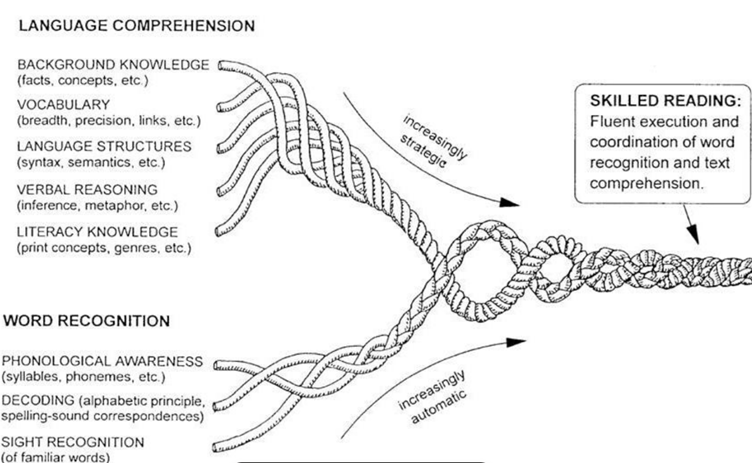
At Gretton, we are committed to developing confident, fluent and enthusiastic readers. Our reading curriculum is underpinned by research from The Science of Reading, ensuring that children are taught the knowledge and skills they need to become successful readers. We recognise that reading is built upon a combination of accurate word recognition, language comprehension and a rich exposure to high-quality texts. Therefore, our approach combines systematic phonics instruction, explicit fluency teaching, meaningful comprehension opportunities and a strong reading-for-pleasure culture.
Systematic Synthetic Phonics
We believe that all children can learn to read successfully. To achieve this, we teach reading through Little Wandle Letters and Sounds Revised, a validated systematic synthetic phonics programme.
Phonics teaching begins in the Early Years Foundation Stage (EYFS) and follows the Little Wandle progression, enabling children to develop secure knowledge of the alphabetic code and apply this confidently to reading and spelling. The carefully sequenced programme ensures that learning builds progressively and systematically as children move through school.
Reading practice sessions are designed to avoid overloading children's working memory and focus on three essential strands of reading:
- Decoding - applying phonics knowledge to read words accurately.
- Prosody - developing reading fluency, expression and understanding.
- Comprehension - developing understanding of the text and its meaning.
This structured approach enables children to gain the fluency and confidence required to become independent readers.
Reading in EYFS and KS1
Alongside Little Wandle, children in EYFS develop their language comprehension through Drawing Club. This approach provides meaningful opportunities to develop communication, vocabulary, creativity, literacy and fine motor skills through storytelling, discussion and drawing.
Drawing Club encourages children to express ideas, explore their imagination and develop confidence in mark-making while deepening their understanding of texts. Texts are carefully selected to reflect children's interests, broaden their understanding of the world and expose them to high-quality literature.
In Key Stage 1, children's comprehension is further strengthened through the rich texts explored during writing lessons and regular opportunities for reading for pleasure throughout the week.
Once children have completed the Little Wandle programme and can confidently read the most challenging level of decodable texts, they move on to Little Wandle Fluency. This provides an important bridge between decodable books and the wider range of texts they will encounter as independent readers.
Reading in KS2
In Key Stage 2, we continue to nurture skilled and thoughtful readers through the use of Literacy Tree texts. These high-quality, award-winning books enable children to see both their own experiences and those of others reflected in literature. The carefully chosen texts promote empathy, broaden cultural understanding and provide opportunities to explore themes of diversity, representation and social justice.
Whole-class reading is structured around three key approaches:
- Fluency Read (fluency practice)
- Extended Read (reading breadth)
- Close Read (text discussions)
This framework provides a balanced and responsive approach to reading instruction while supporting cross-curricular learning and deeper engagement with texts.
The Fluency Read introduces children to the text and supports all readers, including the most vulnerable. The session format includes various elements:
- Explicit teaching of challenging vocabulary;
- Multiple opportunities to read and re-read sections of text;
- Structured discussion to develop and check for understanding (comprehension);
- Teacher modelling of fluent reading (ECHO reading);
During the Extended Read, in Lower Key Stage 2, teachers model the skills required to read at an appropriate pace while encouraging children to re-read, summarise and monitor their understanding.
In Upper Key Stage 2, children increasingly read independently, with the length and complexity of texts gradually increasing.
The Close Read focuses on analysing selected sections of text in greater depth. Through carefully crafted discussion and questioning, pupils explore language choices, authorial intent and deeper meanings within the text. This may be supported through written reflections in Reading Response Books.
Teachers carefully select and explicitly teach vocabulary that is essential for understanding the text and improving fluency.
Accelerated Reader and STAR Reader
In Key Stage 2, Accelerated Reader and STAR Reader are used to support independent reading, monitor progress and promote reading engagement.
Children complete termly STAR Reader assessments, which provide an age-standardised reading assessment and identify each child's reading range, known as their Zone of Proximal Development (ZPD). This helps ensure that pupils choose texts that offer both appropriate challenge and opportunities for success.
Using Accelerated Reader, children select from a wide range of high-quality texts within their recommended reading range to read independently both at school and at home. After completing a book, pupils take a short comprehension quiz which provides immediate feedback on their understanding.
The information gathered through STAR Reader assessments and Accelerated Reader quizzes enables teachers to…
- Monitor reading attainment and progress;
- Identify children who may require additional support or challenge;
- Foster reading independence and accountability;
- Encourage reading for pleasure through informed book choice.
Together, these programmes help to develop reading stamina, comprehension and a positive reading culture across the school.
Intervention
We are committed to ensuring that no child falls behind in reading and provide timely, targeted support whenever additional help is needed.
- EYFS and KS1
Children who are not making expected progress are quickly identified and receive additional Little Wandle daily keep-up sessions. Support is tailored to individual needs and may take place in small groups or through one-to-one teaching.
- KS2
For children who have not yet fully secured the Key Stage 1 phonics programme, targeted phonics intervention is provided to address specific gaps in knowledge and skills.
To bridge the gap between reading fully decodable texts and accessing a wider range of independent reading materials, identified pupils also receive additional guided fluency intervention.
Using Little Wandle Fluency resources, children work in small groups to develop reading accuracy, automaticity, prosody and comprehension, ensuring they can transition successfully to age-appropriate texts and become confident, independent readers.
Reading for pleasure
Every classroom offers a range of high-quality texts, carefully chosen to reflect children's interests, curriculum learning and diverse experiences. Reading is further promoted through our outdoor Reading Nook, which children can access during breaktimes and lunchtimes; after-school book clubs; annual World Book Day celebrations; trips to the Literacy Festival (bi-annually); and our yearly Book Fair.
Children also engage with a wide range of texts during weekly assemblies, including through our Picture News subscription, helping to foster curiosity, discussion and a lifelong love of reading.